Skip to Content

Why Your Windows STILL Have Streaks After Cleaning

February 9, 2026 by
Why Your Windows STILL Have Streaks After Cleaning
Justin Rafael Orloff

Why Your Windows Streak, and How to Clean Them Without Streaks

You cleaned the window. You stood back. The light hit it, and there they were again: the smears, the cloudy patches, the thin lines running down the glass.

So you did it again. Same result. Streaky windows after cleaning are one of the most common things people ask me about, and the answer is almost never the one they expect.

I have been cleaning windows professionally since 1999, first in Melbourne and now in Vienna, and I still clean them almost every working day. Streaks are not a sign that you are careless. They are a sign that something in the method is fighting you, and it is almost always one of seven things.

This guide covers all seven, how to work out which one is yours in about a minute, and the method that removes the problem rather than hiding it.

Why your windows are streaky: find your cause in 60 seconds

Before the detail, match what you are seeing to what is causing it.

What you seeThe likely cause
Cloudy film across the whole paneToo much soap, or a cleaner with additives
Fine lines running the same directionSqueegee rubber is nicked, dirty, or the angle is wrong
Streaks only near the edges and cornersDetailing, or the lack of it
White spots that survive cleaningMineral deposits from hard water
Drying marks appearing as you workCleaning in direct sun or heat
Smearing that gets worse the more you rubDry cloth on dry glass, moving dirt around
Marks between the panes, unreachableA failed seal, not a cleaning problem

That last one matters, and I will come back to it, because no technique on earth will fix it.

The seven causes

1. The cleaner itself

Most consumer window sprays contain additives that make the liquid cling and shine in the bottle. On glass, those additives are what you are left with once the water has gone. That residue is the film.

This is why people search for why their favourite blue spray leaves streaks. The spray is doing what it was designed to do. It is simply that the design goal was a product that looks good on a shelf, not glass that stays clear.

Professionals do not use these products. The solution we use is close to plain water with a small amount of soap, and the reason is exactly this: fewer ingredients, less to leave behind.

2. Too much soap

The most common mistake, and the most counter-intuitive one.

Soap is not the cleaning agent. Water does the cleaning. Soap changes how the water behaves so the squeegee glides instead of skipping. Add too much and you are laying down a layer that has to be removed, which means you have created a second job for yourself.

A few drops in a bucket is enough. If the water looks foamy, there is too much in it.

3. Your water is working against you

If you live somewhere with hard water, the water you clean with is carrying dissolved minerals. The water evaporates. The minerals do not. They dry on the glass as pale spots that look like dirt and behave like paint.

This is the answer to streaks that will not come off no matter how many times you clean. You are not failing to remove them. You are adding to them each time, because your rinse water is depositing more of the same.

Left long enough, hard water etches the glass surface itself, and at that point it is a restoration job rather than a cleaning one.

4. Direct sunlight

Warm glass dries faster than you can work. The cleaning solution evaporates before the squeegee reaches it, and what dries in place is whatever the solution was carrying.

Work the shaded side of the building and follow the shade around as the day moves. On a hot day this single change fixes more streaking than any tool.

5. The wrong tools

Paper towel shreds and leaves lint. Newspaper is a myth that survives because the ink hides what it is not removing. A dry cloth on dry glass moves dirt from one part of the pane to another.

You need three things, and only three:

  • A squeegee with a straight, sharp rubber. Not the suction-cup kind sold for shower doors. A professional channel and rubber costs little and lasts if you look after it.
  • An applicator, a mop or sleeve, to wet the glass and lift the dirt off the surface.
  • A detailing cloth for the edges, kept dry and used for nothing else.

6. Squeegee technique

Two things decide whether the blade leaves the glass clear or leaves a line: the angle and the pressure.

Too steep and the rubber skips. Too flat and it rides over the water instead of cutting it. Too much pressure and the rubber flexes away from the edge you are trying to clear.

There are three turns to learn. Side to side, top to bottom, and the turn with a twist. The first two carry most of the work on ordinary domestic glass, and they are the ones to get right first. The third is what lets you clear a pane in one continuous pass without stopping, and it takes practice with feedback rather than reading.

7. Detailing, or skipping it

Water gathers at the edges and in the corners. It sits there after the squeegee has passed and then runs back down across glass you have already cleared.

A dry cloth, drawn once around the perimeter, is the whole technique. It takes seconds. It is also the step almost everyone leaves out, which is why so many otherwise clean windows have marks only around the frame.

How to clean windows without streaks, step by step

The solution

Cold water and a few drops of washing-up liquid. That is the professional solution for most domestic glass.

Cold, not hot. Hot water evaporates faster, which gives you less working time and more chance of drying marks. On a cold day slightly warm water is more comfortable to work with, but it is comfort rather than performance.

Step 1: Dry wipe first

Run a dry cloth around the frame and over any loose dust, cobwebs and grit before anything gets wet. Wet grit becomes mud, and mud becomes the scratch you notice a week later.

Step 2: Wet the whole pane

Load the applicator, and cover the glass corner to corner including the edges. You are lifting dirt off the surface and putting it into suspension so the squeegee can carry it away.

Work it. The applicator is doing the cleaning, not the squeegee.

Step 3: The squeegee pass

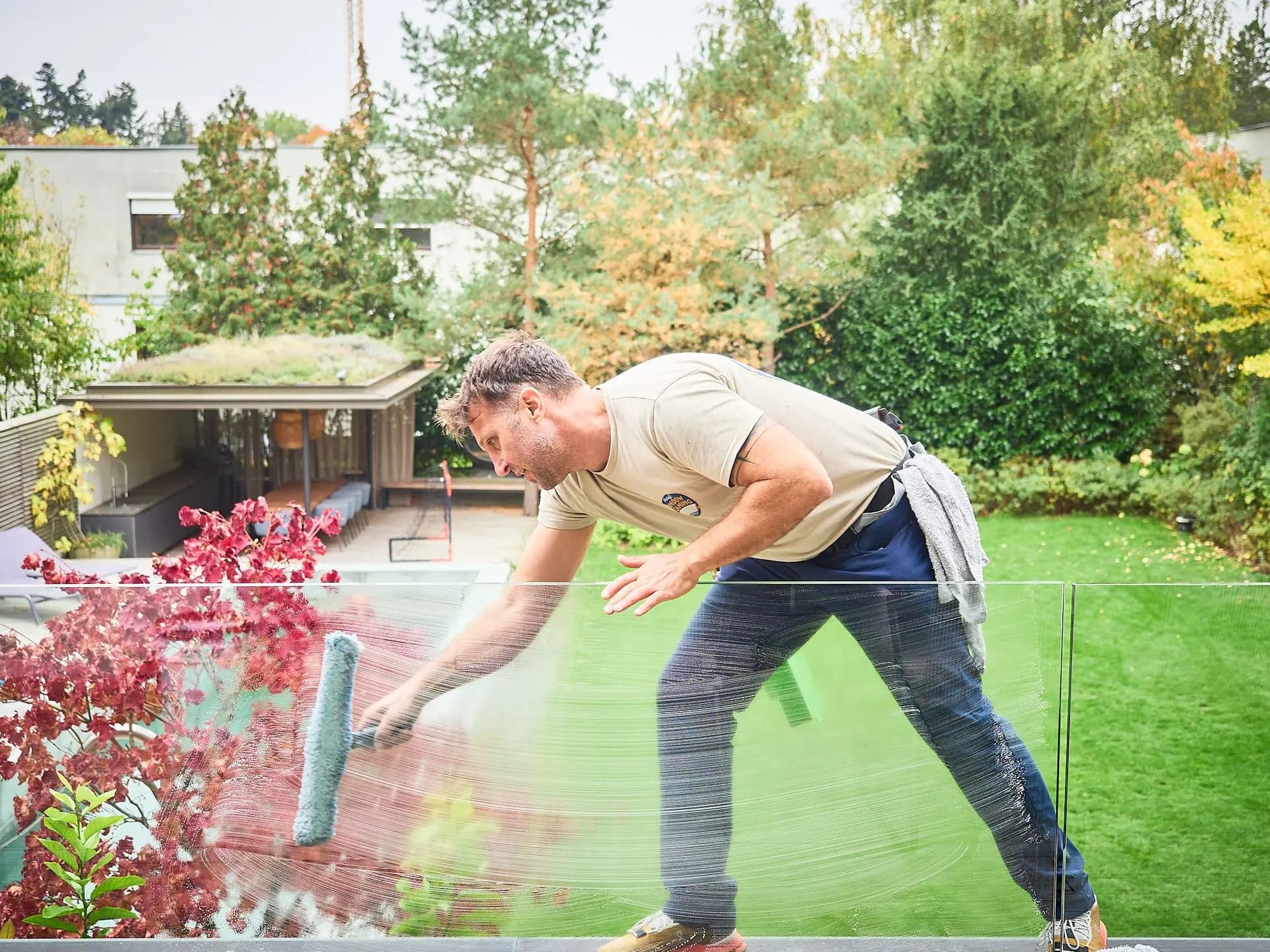
Start at a top corner. Hold the blade at a shallow angle to the glass, keep even contact from end to end, and pull in one steady movement.

Wipe the blade after every pass. A blade carrying water from the last pass will lay a line down on the next one.

Overlap each pass slightly into the cleared area so you never leave an untouched strip.

Step 4: Detail the edges

Dry cloth, once around the perimeter. Do not go back over the middle of the pane. If the middle needs attention, something earlier in the process went wrong and rubbing will not fix it.

Step 5: Look at it properly

Step back and look at the glass from an angle, not straight on. Straight on, glass hides almost everything. At an angle, in reflected light, every mark shows.

This is the step that separates a window someone accepts from a window someone remembers.

Done in this order, with these tools, streak free windows are the normal outcome rather than the lucky one.

The two problems this will not solve

Streaks between the panes. If the marks are inside a double-glazed unit, the seal has failed and moisture is inside the cavity. You cannot reach it, no cleaner reaches it, and no technique will change that. The unit needs replacing. Anyone who tells you otherwise is selling something.

Etched glass. Where hard water has been left long enough, the minerals bond to the surface and begin to eat into it. It looks like a stubborn stain and behaves like damage, because it is damage. It needs a restoration process and sometimes it does not fully come back.

Knowing which of these you are looking at saves you an afternoon of scrubbing something that was never going to move.

Frequently asked questions

Why does my window streak more after I clean it? Almost always residue. Either the cleaner is leaving additives behind, or there is too much soap in the water. Both leave a film that catches the light and looks worse than the dirt did.

What is the best way to clean windows without streaks? Cold water with a few drops of washing-up liquid, applied with a mop or sleeve and removed with a squeegee. The tools matter more than the liquid.

Does newspaper really work? It appears to, because the ink masks what has been left behind. It also leaves lint and transfers ink onto frames. A dry cloth kept for detailing does the job properly.

Why will the streaks not come off at all? Most likely mineral deposits from hard water, which are added to rather than removed by ordinary cleaning. If the marks are inside the glass, the seal has failed and cleaning cannot reach them.

Is it better to clean windows on a cloudy day? Yes. Direct sun dries the solution before you can clear it. Cloud, or simply working the shaded side, removes the problem entirely.

Where this goes next

Everything above is the foundation. Solution, tools, the pass, the detail. Get those right and most domestic glass comes up clear.

What takes longer is the part that cannot be read: the feel of the blade on the glass, the angle that suits your hand, and clearing a large pane in one continuous movement without stopping.

That is what The Skill is for. It is $69 one time, it is built around the turns and the feedback that makes them stick, and it was written by someone who was on a ladder that morning.

It takes three to four days of practice before the basics are solid. Nobody learns this in an afternoon, and anyone promising otherwise has not taught it.

Start with The Skill →

Give the Gift of Crystal Clear Views with Orloffs Online Window Cleaning Training Program