Skip to Content

High-Rise Window Cleaning: Safety, Equipment & Training

High-Rise Window Cleaning: Equipment, Safety, and the Training That Keeps You Alive

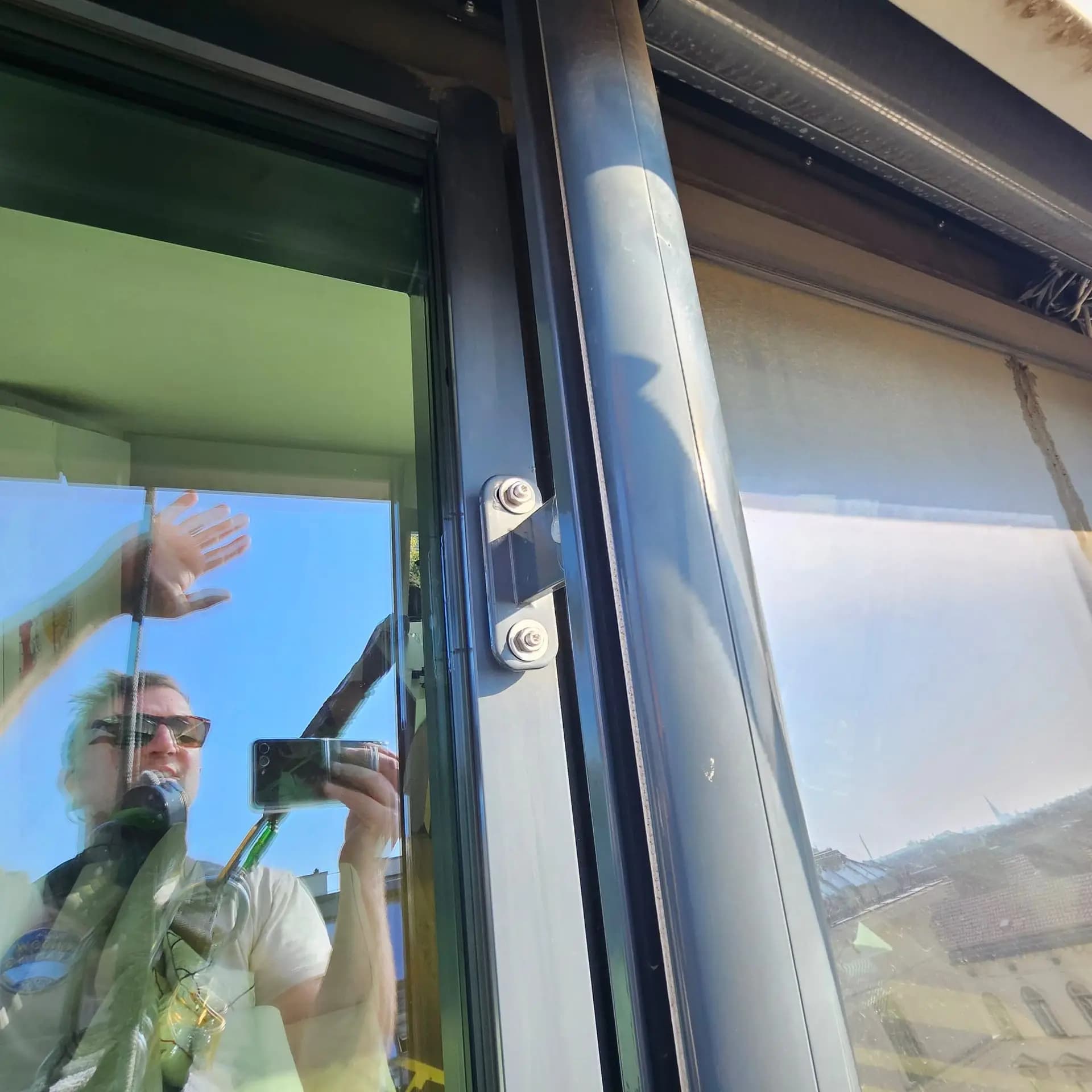
I've cleaned windows on buildings where a gust of wind makes the ropes sway and the glass vibrates against my squeegee. I've hung off the side of Melbourne skyscrapers watching the city shrink below me. I've been featured on Austrian TV for "Extreme Window Cleaning" — and honestly, the cameras made it look more dramatic than it felt.

It felt calm. Controlled. Professional.

That's because I was trained. Properly. As an internationally certified industrial climber, I learned the systems, the protocols, and the discipline that turn high-rise work from terrifying to routine.

If you're considering high-rise window cleaning — whether as a career path, an expansion of your existing business, or simply out of curiosity — this guide covers what you actually need to know. The equipment, the safety, and the training that separates professionals from statistics.

The Honest Truth About High-Rise Work

Let me be direct: high-rise window cleaning is dangerous if you're not trained. Falls from height are the leading cause of death in the cleaning industry. That's not a scare tactic — it's a fact that shapes every decision a professional makes on a jobsite.

But here's what the dramatic headlines don't tell you: properly trained professionals with correct equipment work safely every day, all over the world. The danger doesn't come from the height. It comes from cutting corners — skipping inspections, using worn equipment, rushing through safety checks, or working without proper certification.

I've been doing this for 25 years. The reason I'm still doing it is because I was trained to respect the systems that keep me alive.

👉 Whether you work at ground level or 30 stories up, technique matters first. Start with the free Window Cleaning Manifesto.

Two Layers of Training: Technique + Safety

High-rise window cleaning requires two completely separate skill sets, and most people only think about one.

Layer 1: Window cleaning technique. The 45-degree squeegee angle, consistent pressure, the three fundamental turns, solution application, edge detailing — these are the same techniques whether you're cleaning a ground-floor kitchen window or the 40th floor of an office tower. The physics of clean glass doesn't change with altitude.

This is what our  5-step training system teaches. The Mastery Course covers everything from basic squeegee work to advanced pole technique to eco-friendly pure water cleaning. This technical foundation applies to every window you'll ever clean, at any height.

Layer 2: Working at height safety. This is specific to high-rise work and requires separate, dedicated certification. Rope access systems, harness fitting, anchor assessment, descent and ascent techniques, rescue procedures, equipment inspection — this is life-and-death knowledge that must be learned from certified safety trainers.

Both layers are essential. Technique without safety is reckless. Safety without technique is unproductive — you're hanging off a building, unable to deliver professional results.

My approach: master window cleaning skills first through our training, then pursue safety certification for high-rise work. You'll arrive at your rope access course already knowing how to handle a squeegee at any angle, which lets you focus entirely on the safety systems.

Access Methods: How You Get to the Glass

There are several ways to reach high windows, and the right method depends on the building, the budget, and the job.

Water-Fed Poles (Up to 4-6 Stories)

This is the safest option for mid-rise buildings. You stay on the ground and use a telescoping pole with a pure water system to clean windows up to 50-60 feet above.

Pure water — water that's been filtered to remove all minerals — dries without leaving spots or streaks. The brush on the pole loosens dirt, the pure water rinses it, and it dries crystal clear without squeegeeing.

The Mastery Course covers pole technique and pure water methods in detail. For many cleaning businesses, water-fed poles eliminate the need for ladders entirely on residential and low-rise commercial jobs.

Rope Access (High-Rise)

This is the classic method — descending the building face on ropes using specialised descent devices. It requires IRATA or SPRAT certification and involves two-rope systems (working line + safety line), harnesses, helmets, and thorough anchor assessments.

Rope access is the most versatile high-rise method. You can reach almost any window on any building. It's also the most skill-intensive — you need to clean effectively while managing ropes, positioning yourself correctly, and maintaining safety awareness throughout.

This is where my industrial climbing certification has been invaluable. The training teaches you to work smoothly and efficiently while suspended, managing your tools and cleaning solution without compromising your safety systems.

Bosun Chairs and Cradle Systems

Mechanical platforms — either single-person bosun chairs or larger cradle/gondola systems — are common on buildings with permanent davit or track systems built into the roof structure.

These require platform-specific training and are typically used on buildings designed to accommodate them. They're more stable than rope access but less versatile — you're limited to the track system's reach.

Aerial Lifts and Scaffolding

For some buildings, boom lifts or scaffolding provide the most practical access. These have their own safety requirements and certifications.

Essential Equipment for High-Rise Work

Safety Equipment

  • Harness system (full-body, properly fitted and inspected)
  • Ropes (static and semi-static, appropriate diameter and rating)
  • Descent devices and ascenders
  • Backup safety devices (automatically lock if descent speed exceeds safe limits)
  • Helmets (mandatory on every high-rise job)
  • Anchor systems and slings
  • Lanyards for positioning

Cleaning Equipment (Adapted for Height)

  • Squeegees with tool lanyards (everything gets tethered — a dropped squeegee from 30 stories is a lethal projectile)
  • Belt-mounted solution systems (hands need to be free for rope management)
  • Scrubbers and detail cloths secured to your person
  • Water-fed pole systems where applicable

Personal Protective Equipment

  • Gloves (appropriate for rope work and cleaning)
  • Eye protection
  • Weather-appropriate clothing that doesn't restrict harness fit
  • Communication devices (radio or phone in waterproof case)

Every single piece of equipment gets inspected before every job. Ropes get replaced on schedule, not when they look worn. Harnesses get retired after their rated lifespan. This isn't optional — it's the discipline that keeps you alive.

Safety Certifications: IRATA vs SPRAT

If you're pursuing high-rise work, you need formal safety certification. The two main organisations are:

IRATA (Industrial Rope Access Trade Association)

The international standard, especially recognised in Europe, the Middle East, Asia, and increasingly worldwide. Three progressive levels:

Level 1: Basic rope access — ascending, descending, basic manoeuvres. Supervised work only.

Level 2: Intermediate — rigging, rescue, complex manoeuvres. Can work independently and supervise Level 1 technicians.

Level 3: Advanced — full rigging, rescue management, site supervision. Can oversee all rope access operations.

Cost: Typically $1,500-$2,000 per level. Requires practical assessment and recertification.

SPRAT (Society of Professional Rope Access Technicians)

Recognised primarily in the US and Canada. Similar three-level structure to IRATA.

Both certifications are rigorous, practical, and essential. Choose based on your geographic market — IRATA for international or European work, SPRAT for North American work.

👉 Get your cleaning technique solid first, then pursue safety certification. The Mastery Course covers all the cleaning skills you'll need at any height.

My Journey with High-Rise Work

When I started cleaning windows in Melbourne in 1999, I was terrified of heights. Not a little nervous — genuinely scared.

But the work fascinated me. Watching experienced rope access cleaners descend a building face, working smoothly and confidently, producing sparkling results 30 stories above the street — that was mastery. Real mastery. The kind of skill you can see from a block away.

So I got trained. I earned my industrial climbing certification. I practised until the fear was replaced by respect — respect for the height, respect for the equipment, respect for the systems.

The first time I descended a high-rise in Melbourne, I remember the moment my squeegee touched the glass. Same angle. Same pressure. Same technique. The window didn't care that I was 200 feet up. Clean glass is clean glass.

That experience taught me something important: the fundamental skill of window cleaning is universal. What you learn cleaning a kitchen window is the same technique you'll use on a skyscraper. The height adds complexity — safety systems, rope management, weather considerations — but the core skill transfers completely.

This is why I always recommend mastering technique before pursuing specialisations like high-rise work. The technique is the foundation. Everything else builds on top.

Is High-Rise Work Right for You?

High-rise window cleaning isn't for everyone, and that's perfectly fine. Most of the window cleaning industry works at ground level or with ladders and poles.

Consider high-rise if:

  • Physical fitness is a strength (it's demanding work)
  • Heights genuinely don't bother you (or you're willing to work through mild discomfort — real phobia is a different situation)
  • You're willing to invest in proper safety certification
  • You want to access higher-paying commercial contracts
  • You're attracted to the challenge and the skill involved

Stay ground-level if:

  • Heights cause significant anxiety or physical symptoms
  • You prefer residential work and building direct customer relationships
  • You want lower equipment overhead and simpler logistics
  • You're building a business focused on volume residential cleaning

Both paths lead to successful, rewarding careers. The technique foundation is identical.

Start With the Skill

Whether you're planning to clean the 40th floor or the ground floor, professional technique is where everything begins.

The free Window Cleaning Manifesto gives you the essential foundation in 5 minutes. The Mastery Course covers everything including pole work and pure water systems — skills that apply directly to mid-rise buildings without rope access.

For high-rise specialisation, add safety certification (IRATA or SPRAT) on top of your technique foundation. You'll arrive at the safety course already confident in your cleaning skills, which means you can focus entirely on learning the systems that keep you safe.

Master the skill first. Then decide how high you want to go.

Start Your Training →

About the Author:

Justin Orloff is a professional window cleaner with 25+ years of experience, internationally certified industrial climber, and creator of the world's first AR window cleaning training platform. He has cleaned everything from ground-floor residential windows to Melbourne skyscrapers, and was featured on Austrian TV for "Extreme Window Cleaning." Based in Vienna, Austria.

Why Your Painter Should Never Touch Your Windows (And What to Do Instead)