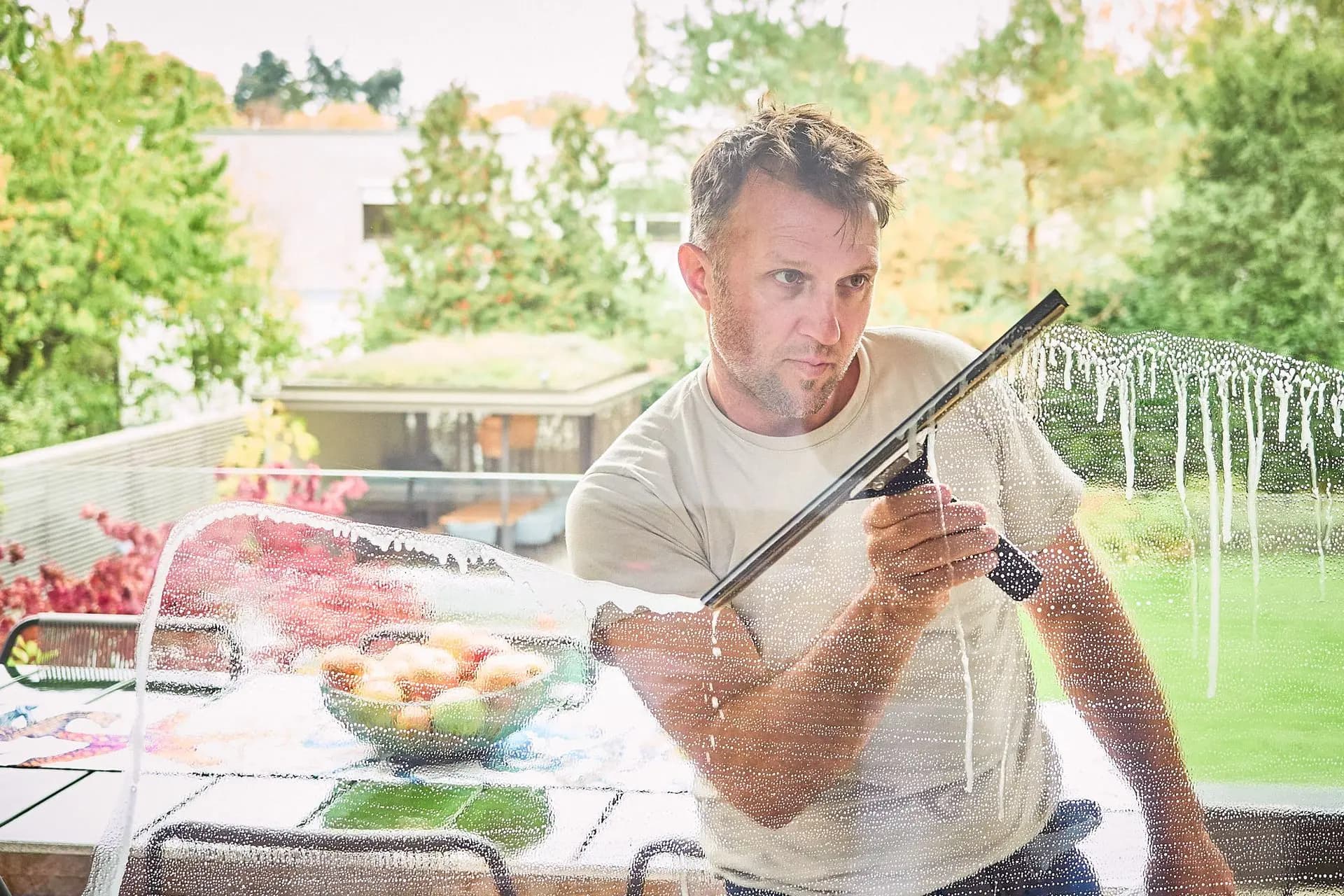
Squeegee Fanning Technique: The Complete Masterclass
The squeegee is the most important tool in professional window cleaning. And most people have no idea how to use one.
The squeegee is the most important tool in professional window cleaning. And most people have no idea how to use one.
I cleaned my first window professionally in Melbourne in 1999. In the 25 years since, I've worked on everything from sky-high commercial glass to cosy family homes across Vienna. I've taught this skill to people who had never picked up a squeegee and watched them get streak-free results within a single session.
Here's what I know for certain: streaks are not a product problem. They're a technique problem. Fix the technique, and the streaks disappear.
This guide covers the full squeegee technique sequence, from your first pass to the most advanced professional move: the fanning technique, also known as the turn with a twist, or what we call in the trade the J tune. That's the move that takes you from competent to quick. From cleaning a window in five minutes to cleaning it in one.
But you can't start with the fan. Every step in this sequence builds the muscle memory you need for the one that follows. So we'll go in order.
If you want the five-minute foundation first, the Window Cleaning Manifesto is free at orloffs.com/the-skill. It covers the essential tools, soap water preparation, and the basic squeegee turns. Come back here when you're ready to go deeper.
Why Technique Beats Product Every Time
Most guides about streak-free windows send you toward a spray bottle and a microfibre cloth. Some suggest newspapers. Others recommend a specific brand of glass cleaner.
Here's the truth: the product is not the problem.
Think of the squeegee rubber the way you'd think of a razor blade when shaving. The edge must be sharp, lubricated, and moving at the right angle to cut cleanly without drag. When those three conditions are right, there are no streaks. When any one of them is wrong, you're wiping and re-wiping the same glass.
The fanning technique, the turn with a twist, is what separates a professional clean from an amateur one. One continuous motion, top to bottom, no lifting the squeegee, no lines. But the motion only works when the preparation behind it is right. That's what this guide is about.
The Tools You Actually Need
Before technique, tools. And before you buy anything, understand what each tool does.
The squeegee consists of four parts: a handle, a channel (the metal bar that holds the rubber blade), a rubber blade, and two rubber clips that hold the blade in place. The channel comes in different lengths. A 20cm and a 35cm cover almost every window you'll encounter. Start with the 20cm. A shorter channel is easier to control, and control is what builds good technique.
The rubber blade is the business end of the squeegee. Treat it with respect. A nicked, worn, or deformed rubber leaves a mark in exactly the same position on the glass, every single pass. Replace or rotate it regularly. The rubber is two-sided: when one edge loses its sharpness, flip it. The overhang past each end of the channel should be between 0.2cm and 0.6cm. Too much or too little, and you'll see it in the result.
The channel must be straight. Before you start, sight down its length. Any bend means uneven contact with the glass, which means a line running the full length of every pass. A straight channel is not optional.
For applying the soap water, you need a T-bar applicator: a T-shaped handle fitted with a microfibre sleeve that distributes soap evenly across the glass. Get a swivel-handle T-bar. The pivot gives you reach into corners, especially when working with an extension pole. A 35cm swivel handle is the professional standard.
For detailing, you need 100% cotton towelling rags. Cotton absorbs well, leaves no lint on the glass, and is reusable. Do not mix your window-cleaning rags with other laundry: lint transfers, and lint on a clean window is the kind of thing that sends you back to the start. Air-dry your rags after washing. Tumble drying creates a static charge that attracts dust.
Getting the Soap Water Right
Soap water is what allows the squeegee rubber to glide cleanly across the glass. Too little, and the rubber drags and squeaks. Too much, and the residue is its own problem.
Fill a 25-litre bucket halfway with tap water. Add one cup of window-cleaning soap. The consistency you're aiming for is the same as washing-up water for dishes: enough soap to shift dirt, not so much that it foams heavily.
Dip the T-bar applicator completely on both sides. Remove the excess water with your hand before you start, so it doesn't drip onto the floor or sill. As you work, re-dip the applicator regularly. This washes away the old soap and the dissolved dirt sitting in it. Fresh soap water onto the glass every few windows makes a real difference to the result.
Agitation: The Step That Decides Everything
Cover the entire glass surface with soap water. Every centimetre, top to bottom.
Then agitate. Using the T-bar applicator, work the soap into the glass with up-and-down or side-to-side motions. The idea is to dissolve the dirt, ready for the squeegee to shave away.
This is the step most people skip, and it's the reason most home cleaning attempts end in streaks.
If the dirt isn't fully dissolved in the soap water and released from the glass, the remaining dirt still stuck will be transported over the glass, leaving smudges or smears. That's not a squeegee problem. That's an agitation problem. The squeegee can only remove what the soap has already dissolved. Ask it to do more than that, and it spreads dirt instead of removing it.
For stubborn spots, insect marks, or built-up grime, pre-soak with extra soap water and give it time to work. A microfibre applicator cover with a light abrasive strip helps with persistent marks. A magic sponge (a melamine foam block with a fine abrasive action) handles what soap water alone cannot.
On sunny days or warm glass, the soap water dries faster than you can work. Switch to the applicator and squeegee combo: hold the T-bar in one hand, the squeegee in the other, and let the squeegee follow the applicator 5 to 10 centimetres behind, catching the soap water the moment it's applied. This keeps the soap wet on the glass and prevents premature drying.
Detail the Frame Before You Squeegee
The soap is on the glass. The dirt has dissolved into it. Before you pick up the squeegee, take your rag.
Use your finger pressed into the rag to get into the edge where the glass meets the frame. Detail the top and both sides. This removes the dust and dirt buildup that the squeegee cannot reach, and it prevents drips from forming at the top of the glass once the squeegee starts moving.
Control the rag in your hand: only touch the glass where you need it. Rotate the rag as you work so you're always using a clean section of cotton. This step takes 15 seconds. Skipping it adds five minutes of cleanup at the end.
Cutting In: The First Connection
"Cutting in" is the first connection of the squeegee rubber to the glass.
There are two ways to do it. Dry cutting in means starting with a dry rubber on a dry edge of the glass: place the squeegee at the top corner of the window and begin your first pass from a clean starting point. This is the right approach for beginners. Clean edge every time.
Moving cut in is more advanced. You start removing the soap water at an angle to the edge of the window, which creates a dry strip that becomes your starting line, and in the same motion removes any chance of a drip forming from the top of the window. This comes with practice. Start dry until the movement feels natural.
The Three Squeegee Turns
There are three squeegee turns in professional window cleaning. They build on each other. Mastering all three, and knowing which one to use on which window, is what produces streak-free results consistently.
Side to Side: The Foundation Turn
Start at the very top edge of the window with a dry rubber on the glass.
Work across the full width in a straight horizontal line. Tilt the squeegee at a slight angle: this directs the water to spill from only one side of the squeegee channel, the lower side. The water follows the angle, not gravity. Control where it goes.
After each pass, wipe the squeegee rubber dry with your rag. A wet rubber carries old soap water into the start of the next line. A dry rubber starts clean.
The overlap between passes should be as small as possible. Less overlap means more glass covered per pass and less cleanup at the end. Close out each pass precisely on the edge: a small increase in pressure against the frame and a slight wrist rotation to adjust the rubber angle.
Repeat until the window is clean.
Top to Bottom: For Tall, Narrow Windows
The same mechanics as side to side, but the passes run vertically. Start in the top corner with a dry rubber. Work straight down. Tilt the squeegee so water spills toward the already-cleaned side of the glass. Wipe the rubber dry after each pass. Maintain the overlap.
On large windows that you can't reach from top to bottom in one motion, combine the turns: top to bottom first for the upper section, using an extension pole (an aluminium or carbon fibre pole that attaches to the squeegee handle, extending your reach from the ground), then side to side to finish the lower section.
The Fanning Technique: The Turn with a Twist
Now we're moving like a professional.
The fanning technique, the turn with a twist, what I also call the J tune in my training program, is a continuous motion from the top of the window to the bottom. No lifting the squeegee. No stopping. One smooth, unbroken pass.
It links every horizontal run into a single fluid movement. This is what speed and quality look like when they arrive in the same moment.
Here's how it works. Start at the top edge of the window. Your thumb is your guide: look at the top of your closed hand and your thumb points left. Begin moving across the window as you would in a side-to-side pass, with the squeegee tilted at the correct angle.
Before you reach the end of the window, begin rotating your wrist: your thumb moves slowly to the right, the back of your closed hand faces you. This rotation redirects the squeegee smoothly downward along the edge of the window, without lifting it from the glass. As it moves down, rotate your wrist back so the thumb returns left, beginning the next horizontal pass in the opposite direction.
That's the J shape. Horizontal pass, smooth turn down the edge, horizontal pass back the other way. Repeat from the top of the window to the bottom.
The timing of the wrist rotation is the key detail: begin the twist before you reach the frame, not when you're at it. If you wait until the squeegee is at the edge, you've run out of space to complete the turn. Start the rotation a few centimetres early. This takes practice. It's a physical skill, not a process you can think your way through.
The turn with a twist comes in three variations: top-to-bottom, side-to-side, and mixed. There is a window for each variation. The mixed fan, combining both directions, is what you use on large windows where neither a purely horizontal nor a purely vertical approach covers the full pane.
Always remember: you are moving all the soap water down the window. Every last drop of it.
At the bottom, close out. Run the squeegee along the bottom frame until you finish flat on the side. Or, if you prefer, add a final 90-degree turn and finish flat on the bottom of the frame.
One more thing: as you work, soap water accumulates inside the channel. When it's full, excess water can spill onto already-clean glass. Bumping the squeegee, pressing the rubber lightly against the glass to release the captured water back into the soapy area below, prevents this. Make it a habit at the bottom of each pass.
When the Squeegee Tells You Something Is Wrong
The rubber jumping, hopping, or squeaking across the glass is not a technique failure. It's a signal. Either the rubber isn't lubricated enough with soap water, or the glass is too warm from direct sunlight. Both leave marks. Re-apply soap water to a smaller section, or wait for the glass to cool before continuing.
A consistent line in the same position across the glass, every single pass: check the rubber first. A nick or cut in the blade leaves that exact mark, in that exact position, until you rotate or replace the rubber. If the line persists after rotating the rubber, sight down the channel. Any bend is your answer.
If the rubber skips or drags at the edges, check your pressure. Too much end pressure deforms the rubber and shortens its life. The rubber edge should glide around the frame seal edge precisely, as close as possible without force.
Finishing: The Detail Work
The squeegee removes the bulk of the soap water. The rag cleans up the rest.
After squeegeeing, use your finger pressed into your 100% cotton rag to get into the edge where the glass meets the frame. Collect any pooled soap water. Rotate the rag constantly, always working with a clean section of cotton against the glass. Replace the rag with a fresh one every few windows.
For outside windows, the squeegee detailing technique saves the rag: use the squeegee to remove the first bulk of soap water from the frame seal area, without touching the clean glass. The rag stays drier and cleaner for longer.
Pole Work: Getting the Angle Right
For windows above arm height, an extension pole is the safe, efficient solution. Modern aluminium and carbon fibre poles are light, strong, and connect to the squeegee handle via a tapered tip.
Finding this useful?
When using a pole, keep the squeegee angle at roughly 45 degrees to the glass, not flat. A flat squeegee on a pole cannot remove the soap water correctly and leaves water behind.
Lock every joint firmly before you start. An unsecured collar clamp means lost pressure control at the squeegee, and the consequence is more cleanup. Bumping becomes more important on a pole too: you have less direct feedback from the tool, so check the channel regularly and bump to release accumulated water before it spills.
A Note on Glass Types
Not all glass responds the same way. Modern architectural glass is frequently heat-treated, coated, or laminated. The technique in this guide works safely across all of those.
What it cannot do is remove hard water stains or mineral deposits. Those are a different problem. Standard soap water and a squeegee will not touch a mineral deposit, and pressing harder risks damaging the surface. Mineral deposits need specialist descaling products and, in some cases, light abrasive action. If in doubt, contact a professional.
For laminated glass, keep soap water away from the edges where the interlayer is exposed. Avoid solvents, acids, and chemical abrasives on any glass type.
Building the Muscle Memory
Reading this guide gives you the map. The turn with a twist, the J tune, only becomes yours through repetition.
The wrist rotation that makes the fanning technique work has to become automatic. You can't think your way into it at speed. The hands have to know it. Most people pick up the side-to-side and top-to-bottom turns in a single session. The turn with a twist takes longer, because the timing of the rotation, starting before the edge, not at it, has to become instinct.
The most efficient way to build that muscle memory without the mess and risk of practising on your own windows is the AR Window Cleaning Training Tool at orloffs.com/the-skill. It's the world's first augmented-reality window-cleaning trainer. Place a virtual window in your own space using your phone or tablet and practise all three turns, including the turn with a twist, in real scale with real feedback. Muscle memory without breaking glass.
Start with the free Manifesto at orloffs.com/the-skill if you haven't already. Five minutes. It's the foundation this entire guide is built on.
The Skill includes the Manifesto, the AR Tool, and the full 90-minute Mastery Course with lifetime access. Video demonstrations of every technique in this guide, plus pole work, pure water cleaning, hard water removal, and the advanced moves. Everything in one place.
Can I use the fanning technique on a small window?
Yes. Start with a 20cm channel and a small pane. The wrist rotation that makes the turn with a twist work is easier to feel and control on a shorter channel. Move to larger channels and bigger windows once the movement is automatic. The technique scales: the principle is the same on a bathroom window and a floor-to-ceiling panel.
What's leaving one consistent line across the glass every pass?
Check the rubber first. A nick or cut in the blade leaves a mark in the same position every single time. Rotate the rubber to the unused side, or replace it. If the line is still there, sight down the length of the channel. A bent channel means uneven contact with the glass across its full length. That's your answer.
How do I know when to replace the squeegee rubber?
There's no fixed number of windows. The practical answer: replace or rotate the rubber when lines appear that weren't there before, when the rubber feels stiff or deformed, or when cleaning requires noticeably more effort than usual. A sharp rubber glides. A worn rubber tells you.
What is the squeegee fanning technique?
The squeegee fanning technique is a continuous squeegee motion that links horizontal passes into one unbroken movement from the top to the bottom of a window. Instead of lifting the squeegee at the end of each pass, the wrist rotates to redirect the rubber into the next pass in a smooth, flowing action. Professional window cleaners also call it the turn with a twist or the J tune. It is the third and most advanced of the three professional squeegee turns, used to clean large windows quickly and without streaks. The wrist rotation must begin before the squeegee reaches the edge of the window, not at it, and the timing of that rotation is what makes the technique a physical skill that improves with practice.
Is the fanning technique hard to learn?
The fanning technique, or turn with a twist, is a physical skill built through repetition. The wrist rotation that redirects the squeegee at the end of each pass must become automatic before the full motion flows correctly. Most people find the side-to-side and top-to-bottom turns straightforward within a single session. The turn with a twist takes longer, because the timing of the rotation must become instinct. Practising on a smaller window with a shorter channel makes the wrist rotation easier to feel. The AR Window Cleaning Training Tool at orloffs.com allows you to practise all three turns in augmented reality, building muscle memory without the risk of practising on your own windows.
What causes streaks even when using a squeegee correctly?
The most common cause is insufficient agitation before squeegeeing. If the dirt is not fully dissolved in the soap water and released from the glass, the remaining dirt still stuck will be transported over the glass, leaving smudges or smears. Other common causes include a worn or nicked rubber blade, a bent squeegee channel, too little soap in the water mix, or a warm glass surface causing the soap water to dry faster than the squeegee can remove it. Check each of these in sequence and the cause becomes clear quickly.
About the author
Justin Orloff is a professional window cleaner with over 25 years of experience, based in Vienna, Austria. He created the world's first AR-powered window cleaning training program at orloffs.com.
25+ Years of Cleaning, Digitally Made Accessible: My industry insights are 100% human-driven. Because I live with dyslexia, I use AI tools to ensure my 25+ years of master experience is polished and readable. To my Editorial Policy
Was this article written by AI?
Yes. AI helps me polish and format my writing because I'm dyslexic. The experience, techniques, and opinions are entirely my own. Full details in my Editorial Policy.